Money was first used as a medium of exchange about 5000 years ago by the Mesopotamian civilization, who used the Shekel. Mesopotamia was a civilization located between the two main rivers in the region, the Euphrates and the Tigris.
Before this time, humans used the barter system to trade goods. The most common form of barter was exchanging agricultural products for other agricultural products, such as wheat for goats. The problem with this system was that to carry wealth with high value, one had to carry many goods, which was very risky and required expensive transportation.
After humans realized the value of goods through market mechanisms, past civilizations used precious metals as a store of value or wealth. The advantage of this method was that humans no longer needed to carry too many goods to buy what they needed.
In the 11th century, humans began to experiment with using paper as currency, although mass adoption did not occur until modern times. The era of paper money is divided into two periods: when one sheet of paper reflected a certain weight of precious metals, and when paper money reflected the financial market and the performance of a country.
Currency Devaluation
Every country is afraid of inflation, a financial term that refers to when a currency loses its value over a period of time. Inflation can occur due to various reasons, such as rising energy or agricultural fertilizer prices that eventually increase the prices of basic needs.
However, inflation does not occur every year. For example, China has experienced several years of negative inflation, which means that its currency is more valuable than in the previous financial period. Nonetheless, it is rare for inflation to be negative by double digits or more in a year.
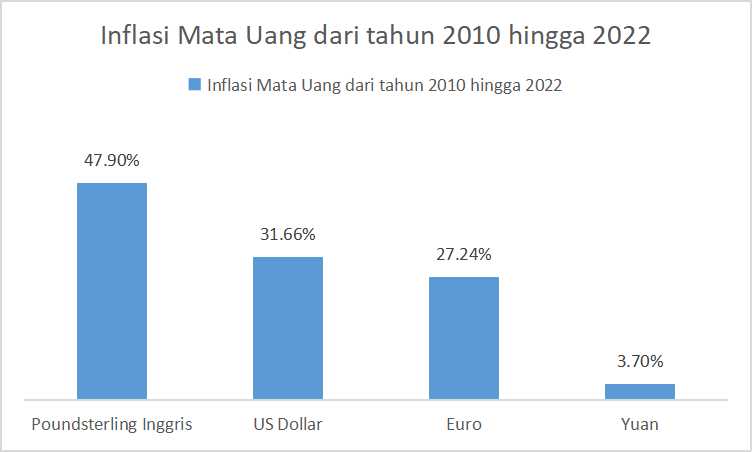
Unexpectedly, Western currencies such as the US Dollar, Euro, and Pound Sterling have experienced inflation of more than 25% between 2010 and 2022.
This means that if in 2010, you received 1 kg of wheat for every 1 unit of currency, in 2022, you would only receive around 720 grams of wheat. However, inflation in a country cannot be generalized, as one country may experience an energy crisis and strong food prices, while another may have a fruit crisis but is safe in terms of energy supply.
Controlling inflation is a difficult task. The Federal Reserve in the United States has continuously raised benchmark interest rates, but the inflation rate remains above 5% within a year.

End of Petrodollars ?
The US Dollar experienced its heyday because of the implementation of the petrodollar system. Petrodollar means that every purchase of oil products must use US Dollar as the payment instrument. This certainly increases the demand for US Dollar and therefore increases its value.
However, recently many countries have started to slowly abandon the US Dollar. This is also due to the policy of The Fed (US Federal Reserve) which chose to print a lot of Dollars during the Covid-19 pandemic, which of course reduces investors' confidence to not rely on the dollar because of the feared devaluation they will receive if they hold it for too long.
One of the currencies that investors are eyeing is the Yuan. If we look at inflation data, China is quite attractive to investors because from 2010 to 2022, it only experienced inflation of less than 4%. Although there are also some who doubt it because the Chinese government is labeled as communist and authoritarian, so they are afraid that the inflation data is manipulated.
In addition, China is a country that can almost meet all its needs independently. Starting from food to chemical products, even China is also one of the countries with very high export value. This makes investors believe that the devaluation of the currency will tend to be small. However, the rise of the Yuan against the US Dollar is only around 25% to 30% compared to 2003.
China Ambitious Vision
China is currently one of the most ambitious countries. They are ready to dominate finance, trade, technology, and even military. The Chinese government has prepared for this by starting with educating children to have reliable skills and supporting investment in these important sectors.
China's recent ambition that has caused a stir in the world is to unite China under the One China Policy. This ranges from making Hong Kong a part of China to wanting Taiwan to also become a part of China. However, this ambition is being met with opposition from the people of Hong Kong and Taiwan. The process of Hong Kong becoming one with China was very tumultuous, filled with demonstrators taking to the streets. Meanwhile, the move to take over Taiwan is expected to lead to one of the major wars in the next 5 years.
Moreover, what is no less important is China's strategy to make the Yuan a rival to the US Dollar in all aspects. While it may be too difficult to replace the US Dollar and make it the only strong currency in the world, the possibility of making the world have 2 polar currencies still exists.
Lately, petrodollar countries such as Saudi Arabia have started to leave the US Dollar in their oil trading agreements. They are currently discussing oil transactions using Yuan instead of the US Dollar. This is a significant pressure for Washington as the trading volume between the two countries is undoubtedly very large, given China's high energy consumption and Saudi Arabia's abundant energy supply capability.

Who Benefiting ?
Every event will have its winners and losers. In terms of leaving the US Dollar, the first to benefit are China and investors holding Yuan. This is because if the world moves towards a dualism of currencies, the rival currency of the US Dollar will definitely become more stable and even increase in value.
However, the rise in the value of Yuan will harm companies outside of China that have borrowed using Yuan as their currency. This is because they will have to spend more money to obtain the same amount of Yuan at a higher exchange rate.
The increase in the value of Yuan does not necessarily benefit Yuan holders, but it will certainly increase the stability of the currency. If the value of Yuan increases, the Central Bank of China will print more money, which will have a significant impact on the economy as it can finance important projects and increase the money supply in the society.
The dualism of currencies in the world and the weakening of the US Dollar will certainly harm Washington. However, if the value of the US Dollar weakens significantly, it will benefit countries and companies outside of the US that have debt with creditors who use the US Dollar as the currency of payment for the loan.